Free shipping in Cyprus on all orders over €50


FRIGG Fairytale: What is the meaning behind the 9 colours?
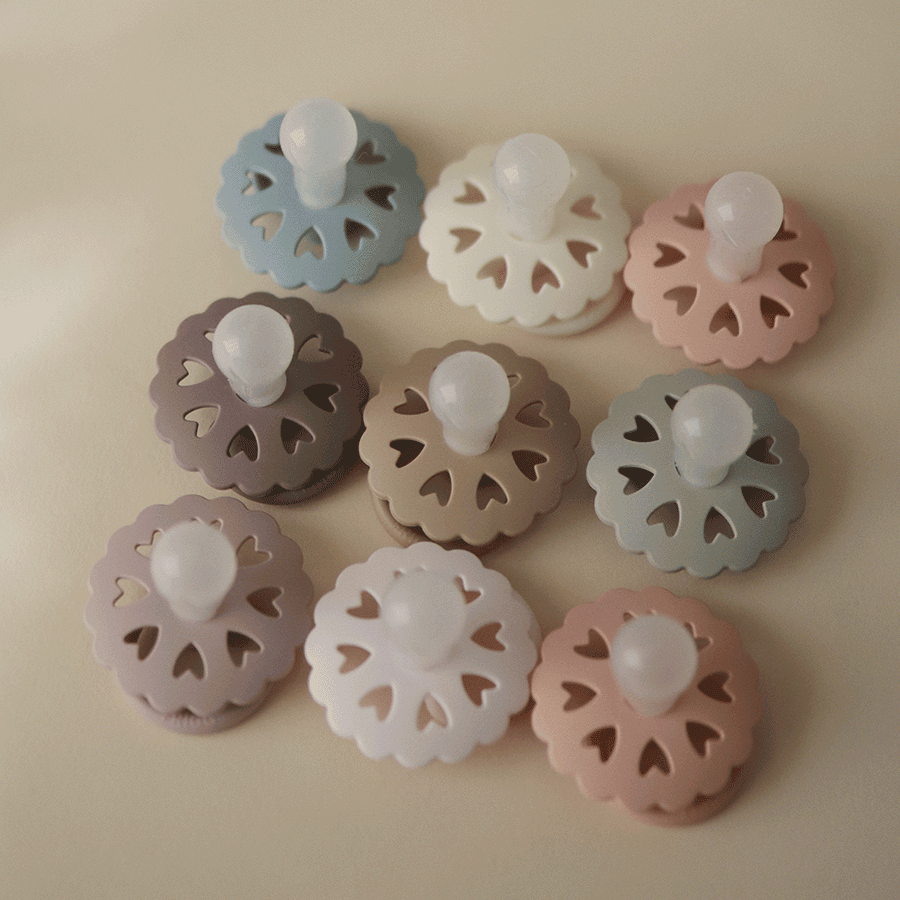
The FRIGG Fairytale pacifier is inspired by the Danish author Hans Christian Andersen, who created an amazing fairytale universe.
The 9 pacifiers of the FRIGG Fairytale collection are named after his fairytales; each of the chosen colours has a hidden meaning, representing a unique element of the fairytales.

Clumsy Hans:
Clumsy Hans follows the life of a boy named Hans who, though perceived as clumsy, possessed a kind and gentle heart. The story emphasizes the virtues of goodness and sincerity, suggesting that true worth lies beyond outward appearances and societal expectations.
The ‘Clumsy Hans’ pacifier represents the colour of the sweet goat that helped Hans find and marry the princess, as he managed to earn her respect and admiration.
“If I can’t have a horse I’ll take the billy goat” said Clumsy Hans. “He belongs to me, and he can carry me very well.” So he mounted the billy goat, dug his heels into its sides, and galloped off down the highway.

Ole Lukoie:
The story of Ole Lukøje revolves around a magical being who is responsible for visiting children and sprinkling magical dust in their eyes to make them dream.
He owns umbrellas with pictures on the inside, each representing a different kind of dream.
If the children were good, he opens the umbrella with beautiful pictures allowing them to have sweet dreams. If the children were naughty, he opens the umbrella with plain, grey pictures.
This slight bluish with a little touch of grey colour of the umbrella is represented by this beautiful pacifier.
“When night comes on and children still sit in good order around the table, or on their little stools, Ole Lukøje arrives.”

The Emperor’s new clothes:
I’m sure we all know the story of the Emperor who was excessively concerned about his appearance, and got deceived by two swindlers who made him believe they can weave a fabric that is invisible to people who are unfit for their role. The emperor and his followers, not wanting to appear unfit, pretend to admire the clothes, even though there is no actual fabric, until a child pointed out the foolishness.
“But he hasn’t got anything on,” a little child said.
This pacifier has the colour of the emperor’s taint.

A little match girl:
“And she quickly struck the whole bundle of matches, for she wished to keep her grandmother with her. And the matches burned with such a glow that it became brighter than daylight. Grandmother had never been so grand and beautiful. She took the little girl in her arms, and both flew in brightness and joy above the earth, very, very high, and up there was neither cold, nor hunger, nor fear – they were with God.”
The story of the little match girl tells the heartbreaking tale of a poor little girl who tries to sell matches in the freezing cold on New Year’s Eve. Ignored and rejected by people passing by, she is afraid to go home because her father will beat her for not selling any matches.
To keep warm, the girl lights the matches one by one to experience the warmth and comfort, until each match goes out, and the harsh reality of the cold street returns. In the end, the little girl succumbs to the cold.
This pink-ish colour of the pacifier represents the girl’s pure heart.

The little mermaid:
The little mermaid follows the story of a young mermaid who is fascinated by the human world. When allowed to swim to the surface, she witnesses a shipwreck and saves a handsome prince from drowning.
Desiring a human soul and the prince’s love, the mermaid makes a pact with the sea witch, sacrificing her voice for legs. The prince falls for another, leading to heartbreak and a threat of dissolution. Yet, her selflessness grants her a chance at an immortal soul through good deeds.
“She was an unusual child, quiet and wistful, and when her sisters decorated their gardens with all kinds of odd things they had found in sunken ships, she would allow nothing in hers except a pretty marble statue. This figure of a handsome boy, carved in pure white marble, had sunk down to the bottom of the sea from some ship that was wrecked. Beside the statue she planted a rose-colored weeping willow tree, which thrived so well that its graceful branches shaded the statue and hung down to the blue sand, where their shadows took on a violet tint, and swayed as the branches swayed. It looked as if the roots and the tips of the branches were kissing each other in play.”
Naturally, this pacifier needed to be a shade of purple, just like the shadow from the weeping willow tree in the garden.

The princess and the pea:
“One evening a terrible storm blew up. It lightened and thundered and rained. It was really frightful! In the midst of it all came a knocking at the town gate. The old King went to open it. Who should be standing outside but a Princess, and what a sight she was in all that rain and wind. Water streamed from her hair down her clothes into her shoes, and ran out at the heels. Yet she claimed to be a real Princess!”
The story unfolds as a prince seeks a true princess for marriage but struggles to find one. A stormy night brings a soaked girl claiming to be a princess. To test her authenticity, the queen places a pea under a pile of mattresses. The sensitive girl feels the pea and proves her royal sensitivity, allowing the prince to marry her.
A true princess has cheeks like the color of a beautiful and sun-kissed peach – even when the rain is pouring down; so does the perfect pacifier.

The snow queen:
“A few snowflakes were falling, and the largest flake of all alighted on the edge of one of the flower boxes. This flake grew bigger and bigger, until at last it turned into a woman, who was dressed in the finest white gauze which looked as if it had been made from millions of star-shaped flakes. She was beautiful and she was graceful, but she was ice-shining, glittering ice. She was alive, for all that, and her eyes sparkled like two bright stars.”
The snow Queen is about a mirror that distorts reality. A boy looked into the mirror which caused him to see only the negative. The Snow Queen kidnaps the boy, and his friend Gerda embarks on a journey to rescue him. Gerda’s love and purity eventually thaw the icy grip of the Snow Queen’s enchantment.
This pacifier has the colour of a delicate frozen winter rose, presented in the colourful and beautiful summer rose garden until the arrival of the beautiful, yet cold Snow Queen.

The ugly duckling:
The story follows a duckling enduring mistreatment and mocking, for its appearance, when it matures into a majestic swan and realizing its true identity.
“But what did he see there, mirrored in the clear stream? He beheld his own image, and it was no longer the reflection of a clumsy, dirty, gray bird, ugly and offensive. He himself was a swan! Being born in a duck yard does not matter, if only you are hatched from a swan’s egg.”
This pacifier had to take the colour of the Danish national bird: the Swan.

Thumbelina:
Thumbelina is about a tiny girl born from a flower. Kidnapped by a toad, she embarks on a series of adventures, meeting various creatures, until she finds herself in the court of the flower-fairy prince and discovers a flower just her size.
As the color of the beautiful rose petals who covered Thumbelina at night, this pacifier has the same magical glow as this little human when she overcomes so many obstacles in the fairy tale.
“A nicely polished walnut shell served as her cradle. Her mattress was made of the blue petals of violets, and a rose petal was pulled up to cover her.”







 Pacifiers
 Pacifier Clips
 Pacifier Case
 Toothbrush
 Portable Changing Pad
 Swaddles
 Dinnerware
 Silicone Place Mats
 Silicone Snack Cups
 Silicone Bibs
 Teethers
 Playful Learning
 Toy Storage Bags